Safeguarding Bioko Island’s Most Vulnerable from Malaria
2025 Malaria Indicator Survey Results: Progress Worth Protecting
March 26, 2026
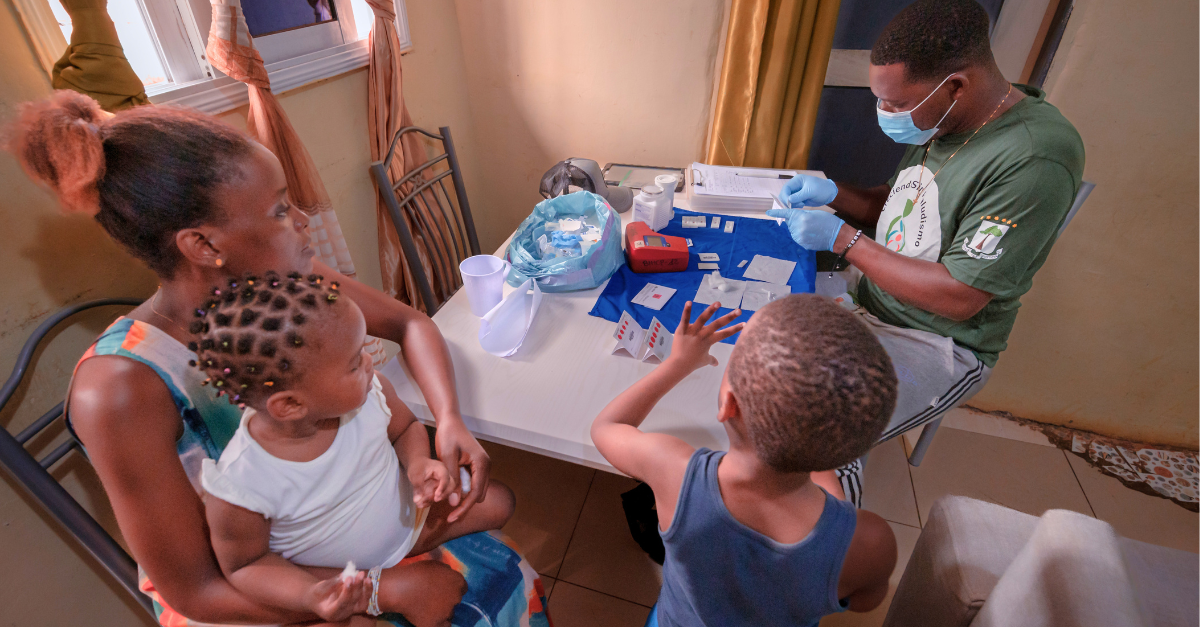
Surveyor testing a mother and her children for malaria.
Malaria prevalence on Bioko Island, Equatorial Guinea, has fallen to an overall historic low of 7.4% in the general population in 2025, thanks to efforts from MCD Global Health’s Bioko Island Malaria Elimination Project (BIMEP) and its partners and funders.
These findings are part of the results of the BIMEP’s annual malaria indicator survey (MIS) that measures key metrics, including malaria prevention, treatment, knowledge about malaria as well as its prevalence. These metrics are particularly important for those most vulnerable to malaria, namely children under 5 and pregnant women.
Young children are at greater risk of developing life-threatening complications from malaria infection given their immune system is still naive to the parasite. Pregnant women are also prone to complications, including placental parasite sequestration and anemia, which pose a significant risk to the mother and child.
The 2025 MIS found malaria prevalence for children under 5 at 3.1%, a significant improvement compared to any year since 2004 when interventions were scaled up on Bioko Island. For pregnant women, prevalence was measured at 6.4%, a more modest decrease compared to recent years but substantially lower than the 35%–42% malaria prevalence in pregnancy reported for the region in the 2025 World Malaria Report.
The findings of the 2025 MIS on Bioko Island reveal that interventions are proving effective at protecting vulnerable populations in a setting previously subdued by extremely high malaria transmission intensity and burden. But the work is not over.
Prevention During Pregnancy Improving, Room for Growth
Malaria prevention in pregnant women heavily relies on their attendance to antenatal care (ANC), where they can access interventions that protect them from getting infected. The findings of the 2025 MIS showed that nearly all women (96%) with a live birth in the last two years reported receiving ANC of some kind on Bioko Island and 88% attended the three recommended visits.
Women have free access to intermittent preventive treatment for malaria with sulfadoxine-pyrimethamine (IPTp-SP) and long-lasting insecticidal nets (LLINs) at public health facilities on Bioko Island. For IPTp, the World Health Organization (WHO) recommends that at least three doses are given during pregnancy, beginning in the second trimester. Last year's survey revealed that 48% of pregnant women received three doses or more of IPTp-SP, nearly 84% received at least one or more doses, and 59% received a LLIN.
Sustaining Control Toward Elimination
“Malaria prevalence on Bioko Island has reached historic lows, particularly among the children who are most vulnerable to it. We have watched this island change since 2004 and know how hard it is to hold that trajectory,” said Guillermo Garcia, MCD’s director of International Programs. “The answer isn't to do more of the same, so we're bringing in new tools and approaches, interpreting the evidence to know where to act and when to adapt. That's a rare position to be in, and we are proud to continue serving Equatorial Guinea on its path to malaria elimination.”
The 2025 MIS suggests Bioko Island is making important progress in reducing malaria; however, the findings also show that the path to elimination will require sustained effort. The MIS is a large, islandwide household study conducted annually as part of the BIMEP. Last year, nearly 5,200 households and 20,000 residents were surveyed.
Earlier this year, MCD signed a five-year, $74.4 million agreement with ConocoPhillips, Chevron Oil, SONAGAS, GEPetrol, and the Government of Equatorial Guinea to continue the BIMEP. The funding will support core malaria interventions, such as indoor spraying, bed nets, surveillance, entomology, diagnostics, and capacity building, as well as introduce new tools aligned with the Equatorial Guinea vice president's Malaria Elimination Vision 2030.