Award-winning Malaria Elimination Project Receives Five-year Renewal in Equatorial Guinea
January 14, 2026
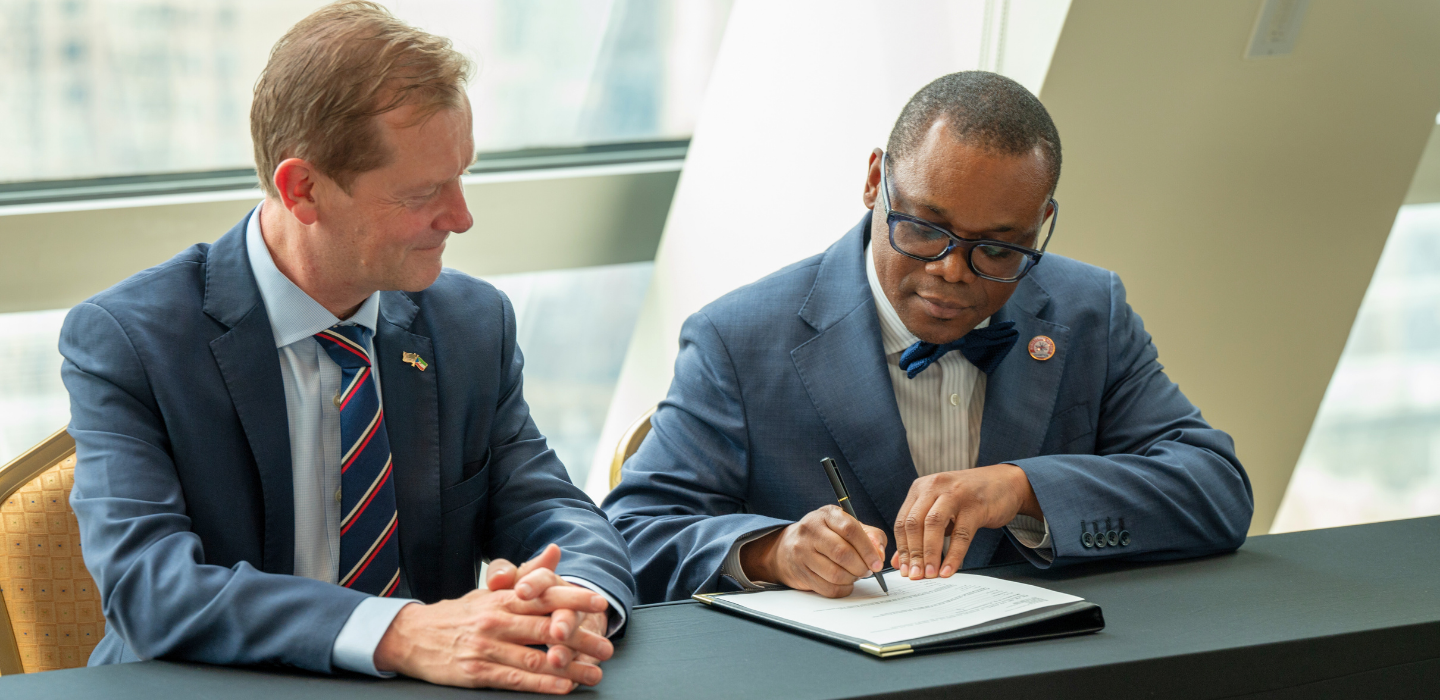
Frederic Phipps (left), president of ConocoPhillips Equatorial Guinea, and Mitoha Ondo'o Ayekaba (right), Equatorial Guinea's minister of Health, Social Welfare and Health Infrastructures, signing the agreement for the Malaria Elimination Vision 2030.
MCD Global Health has signed a five-year, $74.4 million agreement with ConocoPhillips, Chevron Oil, SONAGAS, GEPetrol, and the Government of Equatorial Guinea to continue the Bioko Island Malaria Elimination Project (BIMEP), an award-winning project that aims to eliminate malaria from Bioko Island.
This renewal extends a partnership that has now lasted 22 years and comes at a key moment: The 2025 malaria indicator survey recorded the lowest prevalence ever documented on Bioko Island at 7.2% across all ages, down from a 42% baseline when the project began in 2004.
The funding will support core malaria interventions, such as indoor spraying, bed nets, surveillance, entomology, diagnostics, and capacity building, as well as introduce new tools aligned with the Equatorial Guinea vice president's Malaria Elimination Vision 2030.
For the first time, BIMEP will expand beyond Bioko to include mainland Equatorial Guinea and Annobón Island, giving the project a national scope. The project is also forming new research partnerships on gene drive and transgenics, vaccines and other technologies with the University of California, Davis, Oxford University, and Tsinghua University, alongside existing collaborations with the Swiss Tropical and Public Health Institute, the University of Washington, Texas A&M University, and the University of Florida.
“This investment, made possible by our strong public-private partnerships, allows us to protect lives nationwide and deliver lasting health impact for Equatorial Guinea,” said Guillermo García, director of MCD’s International Programs.
This is all possible thanks to the dedication of the BIMEP team, government partners at the Ministry of Health, Social Welfare and Health Infrastructures, and the relationships built over more than two decades.