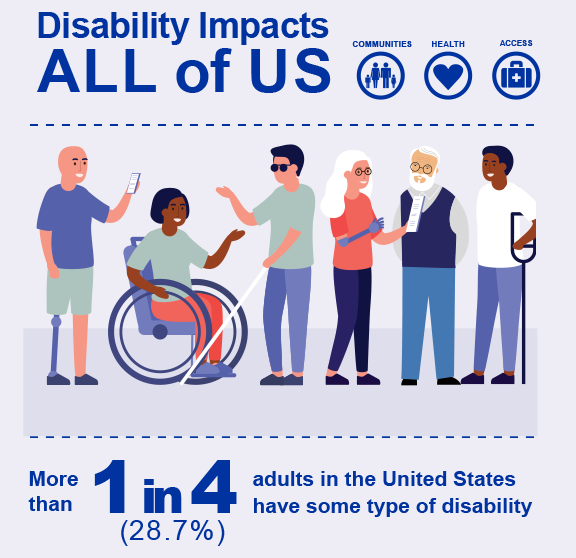
View the full graphic here.
Over 65 million U.S. adults live with a disability, meaning one in four patients has a disability, whether disclosed or not.
Screening For All is an initiative funded by the Centers for Disease Control and Prevention (CDC)'s National Center on Birth Defects and Developmental Disabilities (NCBDDD) to address the significant barriers people with disabilities face in accessing preventive health screenings. Developed by MCD Global Health, this project provides healthcare practitioners with evidence-based tools and resources to make preventive health screenings accessible to all patients.
Disparities
- People with disabilities face multiple barriers to preventive care at individual, interpersonal, and systemic levels.
- People with disabilities are 3 times more likely to report unmet healthcare needs.
- Existing U.S. Preventive Services Task Force (USPSTF) screening guidelines do not address disability-specific considerations, such as accommodations or risk factors that disproportionately affect disabled people.
- Many healthcare professionals do not receive adequate training in disability-inclusive care.
Our Approach
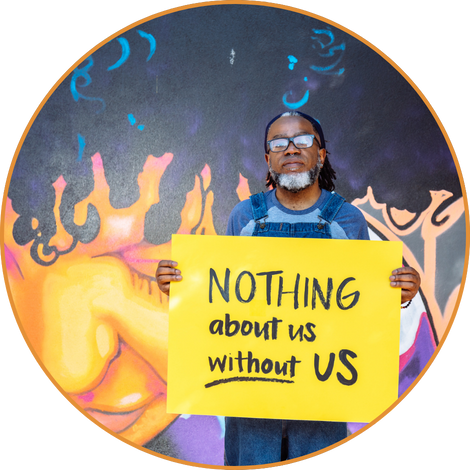
Following the principle “nothing about us without us,” we developed new resources through a community-led process. These resources support practitioner education in disability-inclusive care as well as patient health education. Our Technical Advisory Group of people with lived disability experiences guided the identification of barriers and development of solutions, working alongside clinical experts and comprehensive research review.
Evidence Base
Our work is informed by the Agency for Healthcare Research and Quality (AHRQ)'s comprehensive literature review, entitled, Healthcare Delivery of Clinical Preventive Services for People with Disabilities. For this project, we focused on preventive health screenings recommended by the USPSTF that have an A or B grade recommendation.
Partnership Information
This program is supported by the U.S. CDC of the U.S. Department of Health and Human Services (HHS) as part of a financial assistance award totaling $974,773.00 with 100% funded by CDC/HHS. The contents are those of the author(s) and do not necessarily represent the official views of, nor an endorsement, by CDC/HHS, or the U.S. Government.
Contact
Contact us for feedback, questions, or additions to the resource library:
- Email: screeningforall@mcd.org
- Call: +1 (207) 850-7641
Using These Resources
Screening for All resources are licensed under a Creative Commons Attribution-NonCommercial-ShareAlike 4.0 International License (CC BY-NC-SA 4.0).
These resources are free to use. We want them in as many waiting rooms, clinics, and hands as possible.
You may:
- Print, copy, and share the resources with patients, staff, and colleagues.
- Post them on your organization’s website or intranet.
- Adapt them: add your clinic’s contact information, translate them, or use a section on its own.
- Use them in training and education.
Adapting the resources
If you adapt Screening for All Resources, the CC BY-NC-SA 4.0 license covers our text and layout; however, most images belong to their creators. Some are openly licensed, and you can keep using them while others are licensed to MCD Global Health only. Please email us at screeningforall@mcd.org if you have questions about adapting these resources.
Image and Icon Credits
The Screening for All resources, including the PDFs available on this site, use icons and images from the sources below. We are grateful to the creators who make this work available.
- Font Awesome: Icons from Font Awesome Free (Solid style), © Fonticons, Inc., used under the Creative Commons Attribution 4.0 International License (CC BY 4.0). Icons have been modified: recolored to the Screening for All palette and, in some cases, placed inside a colored circular frame.
- Disabled And Here: Photographs from the Disabled And Here collection, a disability-led stock image project celebrating disabled Black, Indigenous, and people of color. Used under CC BY 4.0. Some images have been cropped or resized. Used under CC BY 4.0. Some images have been cropped or resized.
- The Noun Project: Selected icons from The Noun Project, used under a Noun Project Pro license.
- University of Kentucky Human Development Institute: Selected icons from The Noun Project, used under a Noun Project Pro license.
- The Accessible Icon Project: Accessibility symbols from The Accessible Icon Project, released into the public domain.
- Stock photography : Photography from Adobe Stock, Shutterstock, Pexels, and Unsplash under their respective licenses.
- AI-generated illustrations: Some of the flat vector illustrations showing medical equipment, body positioning, and screening procedures were created using AI image generation tools.