Updated Screening for All Resources Are Now Available
We listened. We updated. Explore the new resources.
July 31, 2026
Today, the full suite of Screening for All resources (20 in all) has been updated and is now available. Every patient and healthcare resource, from screening timelines to accommodation checklists to clinical guides, was reviewed and revised based on feedback from people these resources are designed to support to help make preventive screenings more accessible.
Preventive health screenings can help identify health concerns early, but for many people with disabilities, barriers can show up before, during, and after a visit. Whether it is with scheduling systems, intake forms, communication practices, physical spaces, equipment, referral workflows, insurance questions, or the assumptions people encounter along the way, getting preventive screening is not as simple as making an appointment and showing up.
Screening for All was created to help make preventive screenings more accessible for people with disabilities by giving patients, caregivers, healthcare professionals, office staff, and administrators practical tools they can use right away.
The latest updates reflect a simple commitment: accessibility is not a one-time step, and it should not depend on a patient having to explain, repeat, or negotiate their needs at every point in the care process. Preventive screenings work better when patients have clear information, healthcare teams know what to ask, and systems are designed to carry accommodation needs from one step to the next.
Shaped by lived experience and clinical expertise
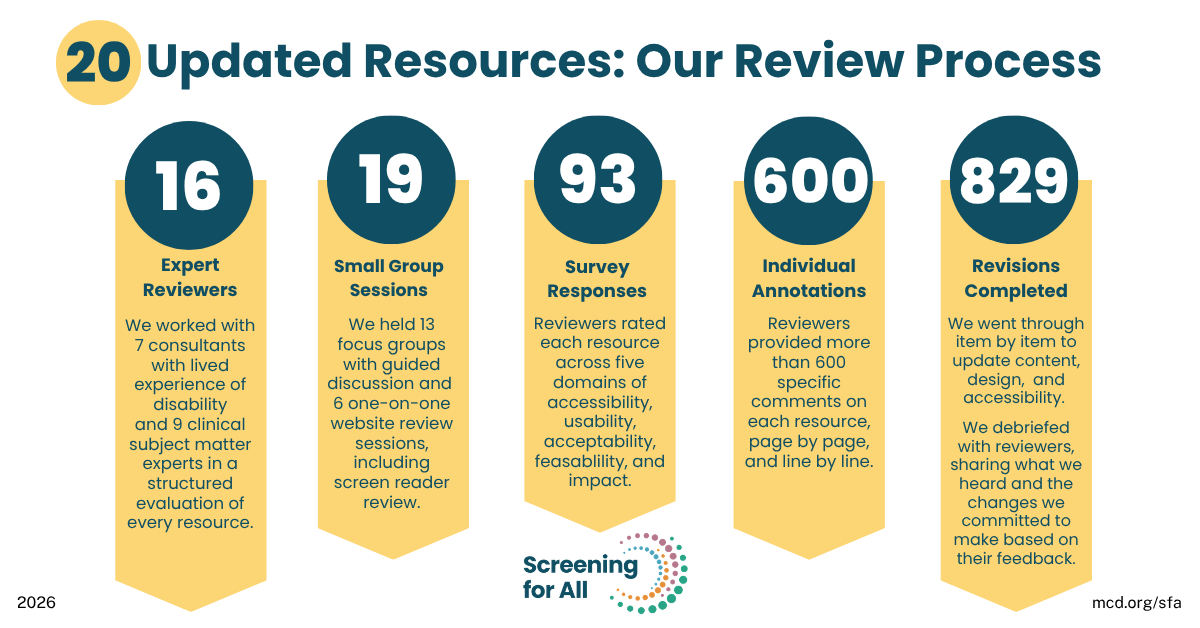
Image Description: This infographic describes the process used to review and update the Screening for All resource library. Twenty resources were reviewed by experts, including people with lived experience of disability and clinical subject matter experts. Feedback was collected through surveys, resource annotations, focus groups, website review sessions, and transcript analysis. Reviewers provided more than 600 annotations, leading to 829 completed revisions across the resource suite. The review process focused on improving accessibility, usability, acceptability, feasibility, and impact, resulting in updates to content, design, and accessibility features throughout the resources.
Over the past year, the Screening for All team completed a structured review of the resources, originally developed in 2025, with consultants who provided their lived experiences of disabilities and clinical subject matter experts. These reviewers annotated each resource page by page, completed surveys, joined focus groups, and conducted website walkthroughs. The team analyzed the feedback, found cross-cutting themes, and worked through suggestions item by item.
This process generated more than 600 individual annotations and led to 829 completed revisions tied directly to reviewer comments. These numbers matter because they show that the updates were driven by specific feedback, not assumptions. Every revision traces back to a comment, concern, or suggestion raised during the review process.
The resources were tested against real questions:
- Are these materials usable?
- Are they understandable?
- Do they reflect what patients actually experience?
- Can healthcare teams use them in real workflows?
- Do they make preventive screenings more accessible, feasible, and respectful?
What changed
Across all the resources, several themes shaped the revisions.
The resources give patients and healthcare teams more concrete ways to start conversations. Telling healthcare providers to “ask patients about accommodations” is not enough. Without concrete language, those conversations may not happen. This round of revisions has built in scripts for healthcare providers to communicate effectively with patients about their access needs, previous screening experiences, and sexual history without assumptions or judgment. Patient resources now include scripts for requesting accommodations, learning more about a screening, and advocating for themselves.
The resources provide clearer guidance for navigating the insurance and coverage questions that often influence whether a screening can move forward. A resource can cover accommodations and accessible care, but if insurance will not cover the screening, it may not happen at all. We added practical guidance for healthcare providers for situations like insurance denials. Patient-facing resources include questions to ask their insurance and a breakdown of how coverage may differ across insurance types.
The resources emphasize that accessibility must move with the patient. Accommodations often get ‘lost’ between the primary care provider (PCP), who orders a screening, and the facility where it actually happens. A patient might have a great conversation with their PCP, then arrive at an imaging center that has no record of it. We restructured the osteoporosis and breast cancer screening practice considerations to have distinct sections for PCPs and imaging centers, plus guidance on what needs to be carried over in referrals and orders. Patient resources encourage directly sharing accommodation needs with both PCPs and the screening site.
The process also further strengthened the accessibility of the materials themselves, including screen-reader compatibility.

“Through my personal experience with autism, ADHD, and visual disabilities, and my professional background in user experience (UX), I see accommodation as a collaborative process where patients and providers find what works together,” shared Tara Raj, a UX consultant from San Francisco who contributed to the review process. “Screening for All’s codesign approach made the full picture visible, which empowered me to help shape resources that meet people where they are at. This project has pushed me to challenge assumptions about what is possible with accommodations elsewhere and start similar collaborations with more organizations.”
Designed for practical use
The updated Screening for All resources include materials for both patients and healthcare professionals. They are intended to be practical, not theoretical. A patient can use a guide to prepare questions before a mammogram, colonoscopy, Pap test, bone density screening, or yearly check-up. A healthcare professional can use a quick reference guide to understand common accommodation options and clinical adaptations for a screening. An office team can use the intake form guidance to improve how patient needs are documented and shared. A healthcare administrator can use the Implementation Plan to identify where accessibility can be built into routine workflows.
Together, these tools support a shared approach. Patients should have clear, usable information, and healthcare systems should be prepared to provide accessible preventive care.
Help share the resources
All updated resources are available at mcd.org/sfa. Organizations that want to help share Screening for All resources with their networks can also use three new dissemination toolkits for:
- Organizations reaching healthcare professionals,
- Patients and caregivers, and
- Cancer prevention networks.
These toolkits provide ready-to-use newsletter copy, social media graphics and captions, slide decks, and print materials. Each toolkit was reviewed by the people who would actually use it: Visit the Toolkits on Google Drive
The feedback loop does not end with this round of updates. Screening for All will continue to learn from patients, caregivers, disability organizations, healthcare professionals, and other partners who use these resources in real settings. Feedback can be sent by email to screeningforall@mcd.org.
Because accessible care is not only about having the right resources; it is about listening, improving, and ensuring that the next person who needs a mammogram, colonoscopy, Pap test, bone density screening, or other preventive service can get the care they need without unnecessary barriers.
Go to the dissemination toolkitsThis program is supported by the U.S. CDC of the U.S. Department of Health and Human Services (HHS) as part of a financial assistance award totaling $974,773.00 with 100% funded by CDC/HHS. The contents are those of the author(s) and do not necessarily represent the official views of, nor an endorsement, by CDC/HHS, or the U.S. Government.